

Wool is grown every day of the year
Better quality wool comes from steady, available nutrition all year round, not just supplementation at joining or obvious stress times.
Ask a classer where a mob struggled through the season and they won’t reach for the paddock records. It’s written into the staple.
A tender spot, a break, a sudden narrowing in the fibre: every one of them marks a point where nutrition dropped away, often months before the wool came off the sheep’s back.
Wool isn’t grown in the weeks before shearing. It’s grown every single day of the year, one small increment of fibre at a time. The strength, evenness and cut of that fibre is set by how steady the nutrition was across the whole twelve months, not by a well-timed dose at joining and another before the shed.
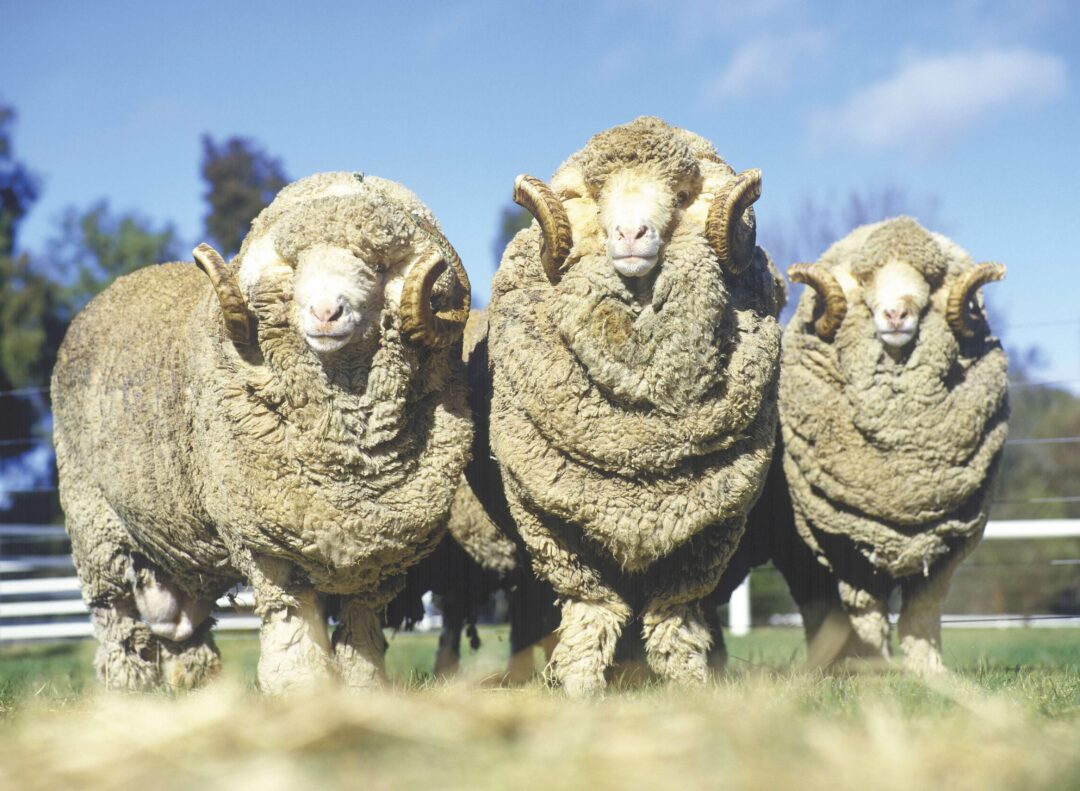
What wool actually is
A wool fibre is almost entirely keratin, a structural protein that is exceptionally rich in sulphur-bearing amino acids.
Those sulphur atoms form cross-links, known as disulphide bonds, between the protein chains. The cross-links are what give wool its tensile strength, its elasticity and its crimp.
Build keratin from a steady supply of the right amino acids and the fibre tends to come through even and sound. Let the supply fall away, even briefly, and the fibre laid down in that window is thinner and weaker. That’s the tender patch that costs you at sale.
The two amino acids that matter most are methionine and serine. Methionine is the key sulphur amino acid the sheep draws on to build wool keratin, and serine sits alongside it in the fibre structure.
Lysine and threonine do their work elsewhere, underpinning muscle growth and gut integrity.
Step 1
Methionine and serine are supplied to the animal
Step 2
Sulphur cross-links form between the keratin chains
Step 3
The fibre gains its strength, elasticity and crimp
Why pasture alone often can’t keep up
Australian pastures, grown on some of the oldest and most weathered soils on earth, often can’t supply those amino acids at the level a productive merino needs, particularly through pregnancy, lactation and seasonal feed changes.
It isn’t as simple as feeding more protein. Most dietary protein is broken down by rumen microbes before the animal ever absorbs it. The microbes build their own protein, which supplies a baseline of amino acids, but through the demanding parts of the year that baseline is frequently short.
Urea feeds the rumen microbes with non-protein nitrogen. It isn’t a source of the preformed amino acids the fibre is built from.
Pasture
Often short of key amino acids through pregnancy, lactation and feed changes.
Urea licks and blocks
Feed the rumen microbes, but only go so far for wool.
Wool isn’t grown in the weeks before shearing. It’s grown every single day of the year.
Consistency, not spikes or troughs
A ‘rising plane of nutrition’, deliberately lifting an animal’s intake, is a specific management tool used mainly ahead of joining. Even then it works best as a slow, managed lift rather than a sudden jump. Across the whole year, the thing that builds sound wool isn’t a rise. It’s consistency: holding an adequate level of the right nutrients in the animal, day after day.
Staple strength comes from an even fibre diameter along the length of the staple. Anything that jolts fibre growth, in either direction, leaves a weak point:
- A cold snap
- A feed gap
- The pull of late pregnancy
- Hungry sheep moved straight onto lush lucerne
How LivestockIQ approaches it
Timing-based, one-off supplementation misses the mark for wool. A dose at joining supports that moment. It does nothing for the fibre being grown eight weeks later. StockForce and ULTRANEX are built on three components working together, delivered steadily across the whole year.
Sixteen amino acids from a natural seagrass and kelp extract, including the methionine and serine that build wool keratin. They’re supplied preformed, so the animal can use them directly rather than relying on the rumen to make them.
Chelated trace elements, protected so they survive the rumen and reach the bloodstream, helping support fertility, immune function and fibre health.
Natural electrolytes from fulvic acid, the carrier that moves the whole load into the cells rather than leaving it in the gut.
The formulation is rumen-protected and released gradually over a six-week period, for a steadier supply of nutrients rather than the spikes and troughs of a daily-fed or one-off system.
One three-day application at the trough. Around six weeks of nutrition.
One application. Six weeks of nutrition.
One three-day application at the water trough lasts around six weeks in the animal. No yarding, no daily handling.
Both products are dosed the same way, every six weeks, all year round. That rhythm is the point.
6 weeks
Of nutrition from one three-day trough applicationStockForce and ULTRANEX
Two products built for year-round wool growing, depending on your enterprise.
StockForce is the sheep specialist. It’s selenium-free by design, so it’s built to sit alongside an existing selenium program, and it’s built to help support wool cut and fibre tensile strength, fertility and lamb survival across the full growing year.
ULTRANEX is the foundation product of the range. It aids wool cut and fibre strength too, while covering cattle and goats as well, making it a natural fit for mixed enterprises that want one core supplement across the whole operation.
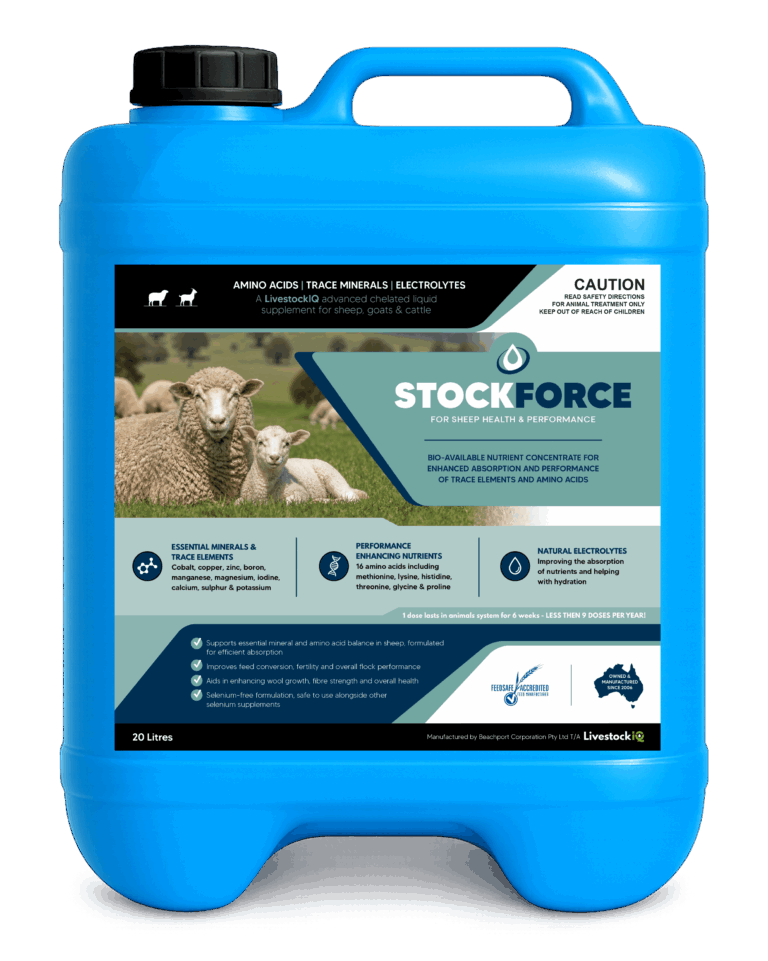
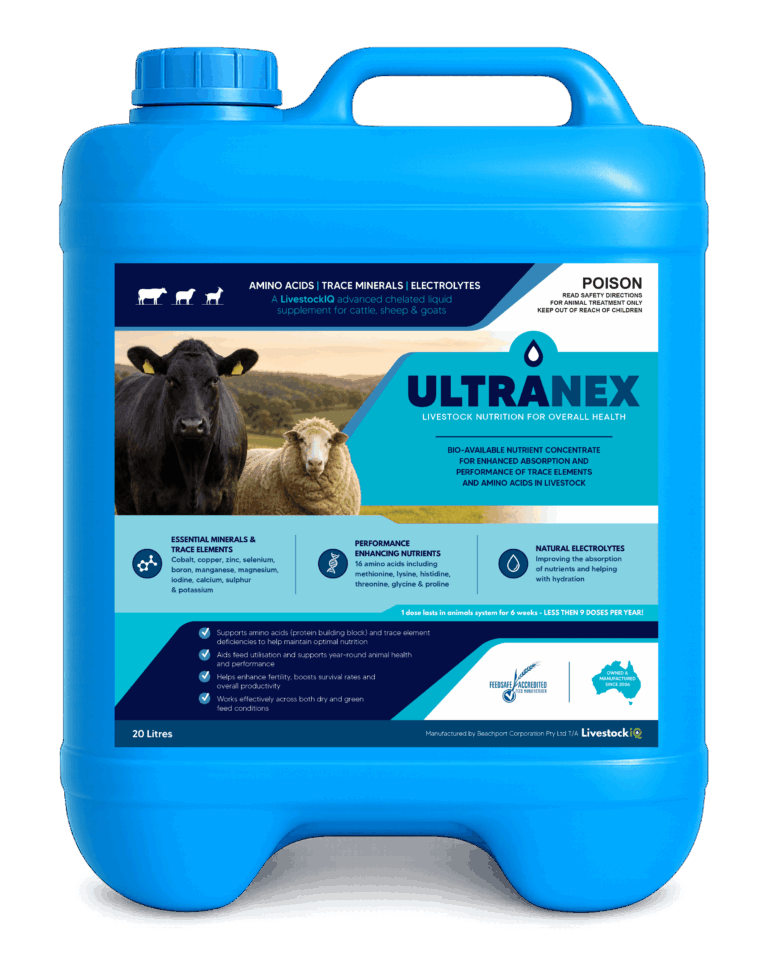
Feeding wool all year round
Wool grows every day, so StockForce and ULTRANEX are dosed every six weeks, right through joining, pregnancy, lambing and the whole wool-growing year. The timing is flexible, so it fits around your own program.
Southern Australian example only
At weaning, use StressGuard
Give StressGuard at weaning for stress and immune support, in place of the regular dose. Avoid doubling up: don't follow a StockForce or ULTRANEX dose with StressGuard only a week or so later. If that means skipping a dose before weaning, that's fine. Then pick the six-weekly routine back up 6 weeks after the StressGuard dose.
Trucking, sales or feedlot entry
Use StressGuard before transport too: dose 3 to 7 days before loading, never within 24 hours of loading. The same flexibility applies, so there's no need to fit in a regular dose just beforehand.
One 3-day application at the water trough. No yarding.
Covers the full twelve months, with no gaps between doses.
Steady nutrition behind every day of fibre growth.
Southern Australian example only, based on a typical higher-rainfall South East SA Merino flock: joining from mid February for about five weeks, lambing from mid July, weaning 12 to 14 weeks after lambing starts. In lower-rainfall areas such as the Mid North, Eyre Peninsula and Murray Mallee, many flocks lamb earlier, around May, so the whole calendar moves about two months earlier. Talk to your local stockist about a program for your flock.
The bottom line for merino breeders
Staple strength, evenness and cut aren’t won in the run-up to shearing. They’re built quietly, day after day, out of the amino acids and minerals the animal has to draw on at the time each fibre is laid down.
Give a merino flock a steady, adequate supply of nutrients through the whole year and you’re supporting the fibre where it’s actually made:
Through pregnancy
Wool is grown every day of the year.
It’s worth feeding it that way.
To talk through a year-round program for your flock, or to find your nearest stockist, get in touch with the LivestockIQ team at [email protected] or find a stockist.