

Nutritional requirements of goats
What goats need, why trace elements come from the soil, and how a year-round program fits.
Goats need energy, protein, water, and 16 different minerals in the right balance to thrive.[1] Most of it comes from pasture and browse, but how much of each depends on the season, the stage of production and, for trace elements, the soil your goats graze.
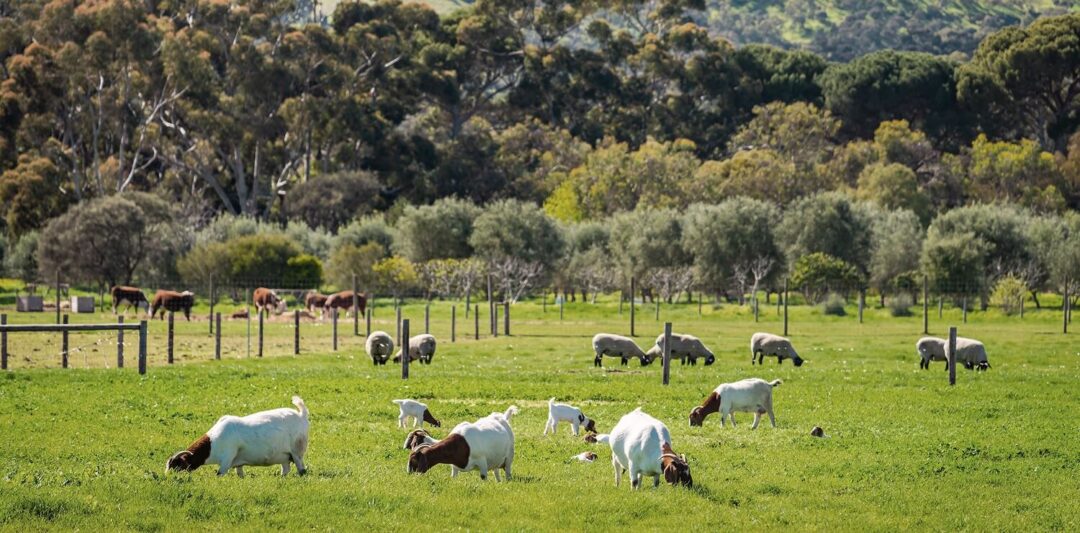
What goats need
- Water: the most important nutrient. On dry feed, weaners drink 4 to 6 litres a day, adult dry goats 5 to 7 litres and does with kids 5 to 10 litres, and that can double over 40°C.[1]
- Energy: the nutrient most likely to limit production, especially in late pregnancy and lactation.
- Protein and amino acids: build muscle, milk, kids and fibre.
- Major minerals: phosphorus and sulphur are the most important for goats, along with calcium, magnesium and sodium.[1]
- Trace elements: needed in tiny amounts, but critical for fertility, growth, immune function and fibre.
Trace element requirements
The figures below are a rough guide to the dietary levels goats need. The higher end of each range applies to fast-growing, pregnant or lactating goats.[1]
| Trace element | Dietary requirement (mg/kg DM) | Why it matters |
|---|---|---|
| Cobalt | 0.08 to 0.15 | Vitamin B12 production, appetite and energy use |
| Copper | 4 to 14 | Growth, fertility, immune function and fibre |
| Iodine | 0.5 | Thyroid function, fertility and kid vigour |
| Iron | 40 | Blood and oxygen transport |
| Manganese | 20 to 25 | Fertility and bone development |
| Selenium | 0.05 | Fertility, kid vigour and immune function |
| Zinc | 9 to 20 | Growth, skin, fibre and immune function |
Source: CSIRO 2007, via MLA Going into Goats Module 7.[1]
Why trace elements come from the soil
Trace element levels in feed depend on the soil, not on how green or plentiful the pasture looks. Selenium-deficient country includes coastal sandy soils, acidic soils and granite or sedimentary soils in higher rainfall areas, and clover-dominant seasons and heavy phosphate fertiliser can lower selenium further. Iodine deficiency is most common in high-rainfall regions.[1]
Balance matters as much as supply. Too much of one mineral can cause a shortage of another. For example, high sulphur can tie up copper.[1]
Copper and goats: goats need copper, but too much builds up in the liver and can cause copper poisoning, so more isn’t always better. Know what your goats are already getting from licks, premixes, drenches and boluses before adding more, and ask your vet or advisor if you’re unsure. On mixed properties where sheep drink from the same trough, remember sheep are especially sensitive to copper, so choose a product suited to both.
Where LivestockIQ fits
A year-round program every 6 weeks gives goats a steady supply of amino acids, trace elements and electrolytes through the water, with no yarding.
| Product | Best for | Selenium |
|---|---|---|
| ULTRANEX | The core year-round product for most goat herds, and mixed operations running cattle or sheep too | Contains selenium |
| StockForce | Herds already on a selenium program (injection, drench or bolus) | Selenium-free |
| StressGuard | Stress events: weaning, trapping, depot entry and transport. Replaces the regular dose | Contains selenium |
| MagBoost | Does kidding onto lush feed or through cold, wet weather: 10 mL first dose, then 5 mL every 3 weeks through the risk window, in place of the year-round product | Contains selenium |
| MEGANEX | High-demand herds (studs, dairy does, twinning herds) and phosphorus-deficient country. Contains phosphorus, with higher copper and zinc. Highest copper in the range: check other copper sources first | Contains selenium |
| OrganicMax* and OrganicGuard* | Certified organic herds: used as for ULTRANEX and StressGuard | Contains selenium |
*This product is allowable for use on farms (or in facilities) certified to the Australian Certified Organic Standard.
Dose rates for goats: adults 10 mL a head, weaned kids 5 mL over 30 kg and 2.5 mL under 30 kg (suckling kids are counted with their doe as one unit), every 6 weeks through the water trough. Don’t put two LivestockIQ products through the trough at the same time.
All LivestockIQ products have a nil withholding period for both meat and milk, and no export slaughter interval (ESI).
FAQ
Can I use a sheep or cattle mineral for my goats?
Goats have their own requirements, so check that any product lists goats on the label. ULTRANEX, StockForce and StressGuard all carry goat dose rates.
How do I know what my goats are short of?
Your vet can test blood or liver samples, and your local agronomist or state agriculture department can tell you which deficiencies are common in your district. Diagnosing mineral deficiencies can be complicated, so professional advice is worth getting.[1]
Sources
Ready to set up your herd's program?
Work out your year-round program with the DoseIQ Calculator, or find your nearest stockist.
Questions? Call (08) 8725 4668 or email [email protected]