

Pre lambing and pregnancy toxaemia
The last 6 weeks of pregnancy carry the highest demand and the highest risk.
Most of a lamb’s growth happens in the last six to eight weeks before it’s born. That’s when the ewe’s demand peaks, her appetite is squeezed, and one bad day can tip a twin-bearing ewe into pregnancy toxaemia. The flocks that get through well are the ones managed steadily through this window.
What’s going on
Most foetal growth happens in the last six to eight weeks of pregnancy, and it speeds up sharply in the final six. A ewe carrying twins needs far more energy than a dry ewe, but the growing lambs take up room in her belly, so she physically can’t eat as much.
When she can’t eat enough energy, she burns body fat. If she burns it faster than her liver can process it, ketones build up in her blood. That’s pregnancy toxemia (twin lamb disease). It moves fast, and late cases rarely recover.
The usual trigger isn’t a long feed shortage. It’s a short interruption: a day off feed for yarding, crutching or shearing, a cold wet snap or a feed change. Ewes in late pregnancy should never be trucked.
What to watch for
- Highest risk: twin and triplet-bearing ewes, over-fat ewes, and ewes that have been underfed for a long stretch
- Ewes standing off on their own, slow to come to feed, or dull
- Apparent blindness, such as walking into fences or wandering aimlessly
- Ewes down and unable to get up
If you see these signs, call your vet straight away. Early treatment gives the best chance. Pregnancy toxaemia, low calcium and grass tetany can look alike, so get the diagnosis right.
Nutrition at this stage
Late pregnancy is when the ewe’s needs climb fastest, while her appetite is shrinking.
- Energy: the main driver. A twin-bearing ewe’s energy needs rise well above maintenance in the last six weeks.
- Protein and amino acids: for the growing lambs, udder development and colostrum.
- Selenium and iodine: linked to lamb vigour and survival in the first days of life.
- Copper: needed for the lamb’s developing nervous system, which forms in late pregnancy.
- Cobalt: the ewe uses it to make vitamin B12, which supports appetite and energy metabolism.
- Magnesium and calcium: demand builds ahead of lactation, and sheep have little usable magnesium reserve, so they need a daily supply.
Lambing onto green feed isn’t a guarantee. Lush spring pasture looks ideal, but it’s mostly water, so a heavily pregnant ewe can struggle to eat enough of it. High potassium in fast-growing feed also competes with magnesium uptake. A sudden switch from dry to lush feed in late pregnancy is one of the swings that can tip ewes over.
Where LivestockIQ fits
Year-round is best. A ewe on a 6-weekly program all year reaches late pregnancy with steady reserves, rather than playing catch-up as her appetite falls. If year-round isn’t possible, the 12 weeks before lambing is the window most worth covering for the ewe and the lambs she’s carrying.
Pregnancy toxaemia is an energy problem, so the answer starts with feed and condition. A trace element and amino acid supplement doesn’t replace energy, and LivestockIQ doesn’t treat or prevent pregnancy toxaemia.
What a trough program does well here is keep the rest of the ewe’s nutrition steady without handling her. That matters, because yarding is one of the most common triggers.
Start 12 weeks before lambing and dose every 6 weeks. This helps support the ewe and the developing lambs through late pregnancy and into lactation. If you’re already on a year-round program, just keep it going.
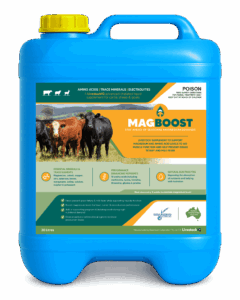
If your ewes lamb onto lush, fast-growing feed or through cold, wet weather, start MagBoost about 6 weeks before lambing. Give a 10 mL loading dose, then 5 mL a head every 3 weeks through the risk window. It supports the peak magnesium and calcium demand of late pregnancy and early lactation, and aids in the prevention of grass tetany. MagBoost contains selenium, so it isn’t suitable for flocks already on a selenium program (bullets, drench or injection). Talk to us about the best option for your flock.
All doses go through the water trough over three days, with no yarding.
FAQ
Will a supplement stop twin lamb disease?
No. Pregnancy toxaemia comes from an energy shortfall, so condition and feed come first. A steady supply of amino acids and trace elements supports the ewe through the highest-demand stage, and trough delivery means no time off feed for handling.
When should I start before lambing?
For StockForce or ULTRANEX, 12 weeks out, so the ewes get two doses before lambing. For MagBoost, about 6 weeks out.
A ewe is already down. Will MagBoost help?
No. MagBoost is used ahead of the risk window, not as a treatment. A down ewe needs your vet.
Ready to set up your flock's program?
Your local reseller can help you choose the right product and timing.
Questions? Call (08) 8725 4668 or email [email protected]