

Kid growth and weaning
Weaning is the biggest change of a kid’s life. A good transition keeps them growing toward turnoff.
Weaning moves a kid off milk and onto a full forage diet, while separating it from its mother. It’s a stress, a diet change and often a health risk all at once, and kids that stall here take longer to reach market weight.
What’s going on
Before weaning, most of a kid’s nutrients come from milk, digested in the true stomach. After weaning the rumen grows quickly to handle a high-fibre diet, which is much less nutritious than milk.[1]
Growth targets depend on breed and feed. MLA guidance puts Boer kids at around 200 g a day and rangeland kids at 100 to 200 g a day in reasonable seasons. Growth rates tend to lift after the winter solstice and ease off as day length shortens.[2]
Weaning stress can open the door to health problems. Coccidiosis is most common in young goats at around six weeks of age and at weaning, and stress can break down the immunity kids have built.[2]
Boer, dairy and rangeland bucklings can be fertile from 3.5 months, so males and females need separating at or soon after weaning. Weaning early enough also gives does time to recover condition before the next joining.[2]

What to watch for
- Kids that go off feed or lose weight in the first week after weaning
- Scouring, especially in kids weaned into crowded or damp conditions
- Shy feeders that get pushed off feed and water
- Kids weaned onto poor-quality or unfamiliar feed
- Weaner water: 4 to 6 litres a head a day on dry feed, and weaners are less tolerant of salty water than adult goats[1]
- Bucklings left with does past 3.5 months
Nutrition at this stage
Weaners are still growing frame and muscle while their rumen catches up, so diet quality matters more than quantity.
- Protein and amino acids: drive muscle growth and frame.
- Energy: fuels growth and helps kids handle the stress of separation.
- Selenium and zinc: support immune function through a stressful period. In selenium-deficient areas MLA guidance treats kids at marking and again at weaning.[1]
- Cobalt: supports vitamin B12 production and appetite. Kids on new pasture can be the first to show a shortfall.
- Copper: supports growth and immune function.
Where LivestockIQ fits
Year-round is best. Kids from a dosed herd start weaning with steadier reserves.
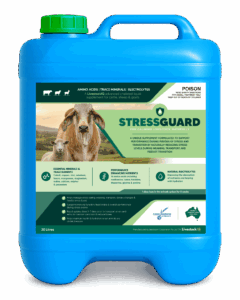
StressGuard at weaning
Use it in place of the regular dose to help support stress and immune function through separation, then return to the year-round program 6 weeks later. Allow at least 2 weeks since the last LivestockIQ dose.
Pick back up every 6 weeks as kids grow out toward turnoff (StockForce for herds on a selenium program). The amino acids help support growth and feed conversion.
Weaned kids are dosed by weight, the same as lambs: 2.5 mL under 30 kg and 5 mL over 30 kg. Kids still suckling are counted with their doe as one unit.
StressGuard contains selenium. If your herd is normally on StockForce because of a selenium program, follow the StressGuard dose rates and instructions exactly, and don’t dose dehydrated animals.
FAQ
At what age should I wean?
There’s no single standard age, and MLA has flagged kid weaning as an area that needs more research.[3] Kids can be weaned early, from about 6 weeks of age or 10 kg liveweight, as long as they’re on a high-energy, high-protein diet. Early weaning can help does in poor condition recover before joining.[4] Bucklings mature early, so they need castrating or separating from the does by about 12 weeks.[5]
My weaners won't drink once StressGuard goes in. Why?
The water may be too concentrated. Use the ProDispenser to meter the dose over three days, or split it across morning, midday and evening.
Sources
[1] MLA, Going into Goats Module 7: Nutrition.
[2] MLA, Going into Goats Module 6: Husbandry.
[3] MLA, KIDStart: Optimising kid weaning success (terms of reference, FY26).
[4] MLA, Going into Goats Factsheet 7: Production from a breeding doe.
[5] Australian Cashmere Growers Association, The Australian Cashmere Story.
Ready to set up your herd's program?
Use the DoseIQ Calculator to work out your weaner doses, or find your nearest stockist.
Questions? Call (08) 8725 4668 or email [email protected]