

Transition and calving
The weeks either side of calving set up the whole lactation.
The transition period runs from four weeks before calving to four weeks after. It’s the highest-risk time of a dairy cow’s year, and around 80% of cow health problems happen within four weeks of calving.[1]
What’s going on
In a few days, a cow goes from carrying a calf to producing colostrum and then milk. Her calcium need jumps from around 30 g a day before calving to 50 to 80 g a day once she’s milking.[2] Her body can’t mobilise calcium that fast, so blood calcium drops. That’s milk fever (hypocalcaemia).
Most cases happen from calving to about three days after.[3] For every cow that goes down, there may be eight or more with low blood calcium that show no obvious signs.[4] Dairy Australia calls milk fever a gateway disease, because it’s linked to mastitis, ketosis, retained placenta and a displaced abomasum, and can affect how well the cow gets back in calf.[4]
Magnesium matters too. It’s needed for the hormones that release calcium from bone, and the body has no ready store of it, so it has to come in every day.[2][5] Grass tetany (low blood magnesium) is a risk for cows in milk on lush, grass-dominant pasture, especially paddocks heavy in potassium or nitrogen, or when bad weather cuts feed intake.[5]
Pasture-based herds carry a high risk of both milk fever and grass tetany.[4] Fast-growing, heavily fertilised or effluent paddocks can be high in potassium, which makes both harder for the cow to manage.[4]
Cows most at risk
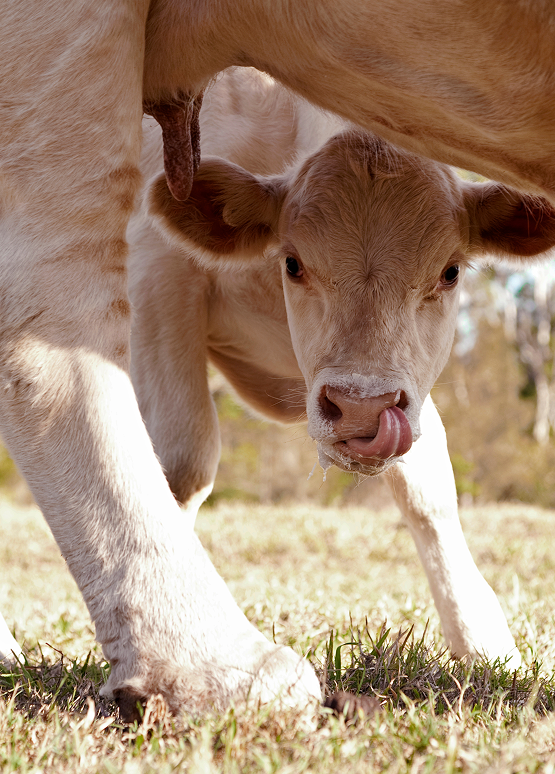
- Older cows: risk rises with each lactation[2]
- Jerseys, which have about twice the risk of Holsteins[2]
- Cows carrying too much condition, above a score of 6 out of 8[2]
- Herds calving onto lush, fast-growing grass or through cold, wet weather[5]
What to watch for
- Cows that are excitable, trembling or wobbly in the first days after calving[3]
- A cow down on her chest, dull, with cold ears[3]
- Slow cleaning (retained placenta) or a run of sick fresh cows
- Cows twitching, staggering or down on green feed, which can point to grass tetany
Milk fever and grass tetany can look alike, and a down cow needs your vet straight away.
Nutrition at this stage
- Calcium and magnesium: the minerals in heaviest demand as milk production starts. Diets before calving often target higher magnesium, around 0.45% of dry matter.[2]
- Selenium, zinc and copper: support immune function through calving, when cows are most vulnerable. Low selenium is linked to retained placenta.[6]
- Amino acids: support the cow as she starts producing colostrum and milk.
Where LivestockIQ fits
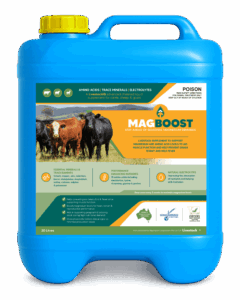
Built for the calving risk window. For cows calving onto lush feed or through cold, wet weather, it’s started about 6 weeks before calving with a 50 mL loading dose, then 25 mL every 3 weeks through the risk window, in place of the year-round product. It supports the peak magnesium and calcium demand of late pregnancy and early lactation, and aids in the prevention of grass tetany and milk fever.
MagBoost has a nil withholding period for both meat and milk, and if trough dosing doesn’t suit (such as springers in a feed pad), it can also be poured on hay or mixed with feed at the same dose rate, split over two consecutive feeds. Some producers allow an extra 10% for wastage.
Never run two LivestockIQ products through the trough at the same time.
FAQ
Does MagBoost replace a transition diet?
No. A transition diet, balanced with your nutritionist, is the foundation. MagBoost works alongside it, supplying magnesium, calcium, trace elements and amino acids through the water.
A cow is already down. Will MagBoost help?
No. MagBoost is used ahead of the risk window. A down cow needs your vet straight away.
Can I use MagBoost on dry cows and the milking herd?
Yes, through the risk window. Once the risk has passed, the herd goes back to MEGANEX or ULTRANEX.
Sources
[1] Dairy Australia, An Introduction to Transition Cow Management.
[2] Dairy Australia, Transition Cow Management: Technical Review.
[3] Merck Veterinary Manual, Parturient Paresis in Cows.
[4] Dairy Australia, Transition Cow Management for Dairy Farmers.
[5] Merck Veterinary Manual, Hypomagnesemic Tetany in Cattle and Sheep.
[6] Merck Veterinary Manual, Nutritional Requirements of Dairy Cattle.
Ready to set up your herd's program?
Plan your MagBoost program with the DoseIQ Calculator, or find your nearest stockist.
Questions? Call (08) 8725 4668 or email [email protected]