

Pre-calving and late pregnancy
Most of the calf is grown in the last three months. So is next year’s calf.
Most foetal growth happens in the final three months of pregnancy. The cow’s condition coming out of this stage decides how well she calves, how she milks, and how quickly she gets back in calf. It’s the stage that sets up two calves at once.
What’s going on
As the calf grows, the cow’s needs climb steadily through the last trimester. Many southern herds calve into a cold winter or onto the tail of a dry autumn, when feed quality is low.
Cows that lose condition now calve lighter and take longer to start cycling again. That’s how a herd’s calving slips later each year.
Cutting feed to heifers late in pregnancy to keep calves small is a common belief, but it doesn’t work. Restricting feed in the final trimester actually increases calving difficulty.[1]
What to watch for
- Cows sliding below condition score 3 in the last three months
- First-calf heifers that are light or still growing (aim for fat score 3 and over 450 kg before calving for British breeds)[2]
- Cold, wet weather or a feed drop close to calving
- Cows calving onto lush, fast-growing feed, where grass tetany and milk fever risk rises (see the grass tetany page)
- Cows in late pregnancy should not be trucked
Nutrition at this stage
- Energy: the main driver. A 500 kg cow in the last third of pregnancy needs about 59 MJ a day just to hold weight, and about 75 MJ to keep gaining slightly.[3]
- Protein and amino acids: for the growing calf and udder development.
- Selenium, copper, iodine and cobalt: support the developing calf and its vigour at birth.
- Magnesium and calcium: demand builds ahead of lactation, and cattle need a constant daily supply of magnesium.
Calving onto green feed isn’t a guarantee. Lush, fast-growing pasture can be very high in water and potassium, which competes with magnesium uptake. A sudden switch from dry to lush feed close to calving raises grass tetany risk.
Where LivestockIQ fits
Year-round is best. A cow on a 6-weekly program all year reaches the last trimester with steady reserves. If year-round isn’t possible, the 12 weeks before calving is the window most worth covering.
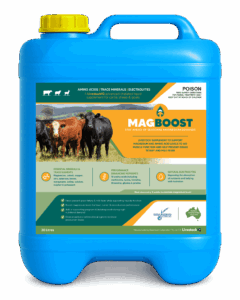
If your cows calve onto lush feed or through cold, wet weather, start about 6 weeks before calving. Give a 50 mL loading dose, then 25 mL every 3 weeks through the risk window. It supports the peak magnesium and calcium demand of late pregnancy and early lactation, and aids in the prevention of grass tetany.
All doses go through the water trough over three days, with no yarding of heavily pregnant cows.
FAQ
Should I cut back feed to heifers so the calves are smaller?
No. Restricting feed in the last trimester increases calving difficulty. Keep heifers growing steadily.
When should I start before calving?
For ULTRANEX or MEGANEX, 12 weeks out. For MagBoost, about 6 weeks out.
Ready to set up your herd's program?
Find a stockist near you, or call the team on (08) 8725 4668 to plan your pre-calving program.
Questions? Call (08) 8725 4668 or email [email protected]
Running cattle in the north instead? See Northern systems