

Feedlots
Induction and exit are where lambs lose the most ground.
A lamb feedlot makes its money in the middle weeks, when lambs are settled, eating hard and gaining every day. It loses money at the two ends. Lambs that are slow to start eating after induction, or that drop weight on the way out, cost you kilos and days you don’t get back.
What’s going on
Induction stacks several stresses at once: trucking, mixing with strange lambs, a new pen, new water and a switch from pasture to grain. Lambs that don’t find the feed and water quickly fall behind, and the risk of grain poisoning is highest while they’re being introduced to grain.
The middle weeks are about steady intake. Any interruption in feed or water, or a sudden jump in grain, knocks growth and can bring on acidosis.
Exit brings curfew, yarding and trucking again. Every hour off feed and water costs liveweight, and stressed lambs arrive lighter.

What to watch for
- Lambs not at the feed bunk or trough in the first few days (shy feeders)
- Scouring, lameness or bloat as grain intake builds
- Sudden deaths (call your vet straight away)
- Wethers straining to urinate, which can point to urinary calculi on high-grain rations
- Growth stalling mid-feed, often from a water, feed or weather problem
Nutrition at this stage
Fast-growing lambs on a high-energy ration have needs that grain alone doesn’t always meet.
- Protein and amino acids such as lysine and methionine: the building blocks of muscle, and often the limit on how fast lambs grow.
- Calcium and phosphorus balance: grain is high in phosphorus and low in calcium, which is linked to urinary calculi in wethers.
- Zinc: supports hoof and skin health and immune function under feedlot conditions.
- Selenium: supports muscle health in fast-growing lambs.
- Electrolytes and water: hydration matters most at entry and exit, when lambs are stressed and slow to drink.
Lambs that arrive with low reserves take longer to start eating and are more likely to struggle through induction.
Where LivestockIQ fits
Lambs from ewes on a year-round program at home tend to arrive with better reserves. In the feedlot itself, the focus shifts to the two high-stress ends of the stay.
StressGuard is built for exactly the two ends of a feedlot stay.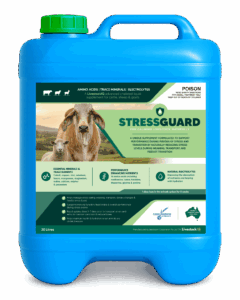
On entry
Before exit
StressGuard contains selenium. If your flock is normally on StockForce because of a selenium program, follow the StressGuard dose rates and instructions exactly, and don’t dose dehydrated animals.
- Between doses: leave at least 2 weeks between LivestockIQ doses and never run two products through the trough at once. For the weeks between entry and exit, call head office on (08) 8725 4668. Every feedlot and ration is different, and we’ll build the program around yours.
| Timing | Product | Dose |
|---|---|---|
| Entry | StressGuard | 2.5 mL (under 30 kg) or 5 mL (over 30 kg) a head |
| Mid-feed | Tailored program | Call head office |
| 3 to 7 days before trucking | StressGuard | 5 mL a head (over 30 kg) |
FAQ
Can I dose StressGuard on the day the truck arrives?
No. That’s too late. Dose 3 to 7 days before trucking, and never within 24 hours of loading.
The lambs won't drink once StressGuard goes in. Why?
The water may be too concentrated. Use the ProDispenser to meter the dose over three days, or split it across morning, midday and evening.
Ready to set up your flock's program?
Your local reseller can help you choose the right product and timing.
Questions? Call (08) 8725 4668 or email [email protected]