

Grass tetany and milk fever
Grass tetany strikes when the feed looks its best.
Grass tetany hits hardest on lush, fast-growing feed, the paddocks that look like the best on the place. Cows need magnesium every day and have no useful reserve, so when the pasture blocks it, levels fall fast. The answer is getting ahead of the risk window, not reacting once a cow is down.
What’s going on
Grass tetany (hypomagnesaemia) happens when blood magnesium falls too low. Lush, grass-dominant pastures and cereal crops are the usual culprits. Fast-growing feed is high in potassium, the main thing that interferes with magnesium absorption, and low sodium makes it worse.[1]
The risk is highest in lactating cows and older cows, because magnesium absorption falls with age. Fat cows and cows calving in autumn or winter are also at higher risk. In southern Australia it usually strikes in late autumn and winter, and cold, wet, windy weather or a sudden temperature drop can tip cows over.[1]
Milk fever (low blood calcium) is a separate problem around calving, in late-pregnant cows and cows with calves at foot. The two can occur together and look alike.[1]
What to watch for
- Cows that look wary, nervous or overly alert
- Twitching, muscle spasms or a stiff, staggering walk
- Cows down and convulsing
- Sudden deaths on lush feed, especially after a cold snap
If you see these signs, call your vet straight away. A down cow needs urgent treatment.
Nutrition at this stage
- Magnesium: needed every day. Lush feed can supply enough on paper, but high potassium stops the cow absorbing it.
- Sodium: low sodium is a known risk factor.
- Calcium: demand jumps at calving as milk production starts.
- Energy: cows that go off feed in bad weather lose their daily magnesium intake too.
- Amino acids such as aspartic acid, glycine, glutamic acid and proline: help carry minerals, including magnesium, into the bloodstream.
The best-looking feed carries the highest risk. A mob can look in top condition and still be days away from a problem.
Where LivestockIQ fits
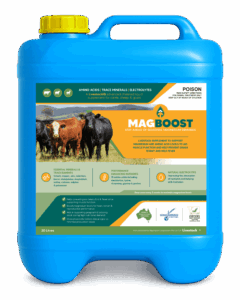
MagBoost is built for this window. It supports the peak magnesium and calcium demand of late pregnancy and early lactation, and aids in the prevention of grass tetany.
- When to start: about 6 weeks before calving, or before cattle go onto lush feed in late autumn and winter.
- How much: a 50 mL loading dose for adult cattle, then 25 mL a head every 3 weeks until the risk eases.
- Why every 3 weeks: cattle can’t store magnesium, and lush feed blocks uptake just as demand peaks.
Outside the risk window, ULTRANEX every 6 weeks (or MEGANEX for high-demand cattle) keeps trace elements and amino acids steady. Switch to MagBoost for the risk window, then back again. Never run two LivestockIQ products through the trough at once. MagBoost is proactive, not a treatment.
FAQ
My cows look great on this feed. Why would they need magnesium?
Because tetany-prone feed looks its best. High potassium blocks magnesium absorption, however good the feed looks.
A cow is already down. Will MagBoost help?
No. MagBoost is used ahead of the risk window. A down cow needs your vet straight away.
Ready to set up your herd's program?
Your local reseller can help you choose the right product and timing.
Questions? Call (08) 8725 4668 or email [email protected]
Running cattle in the north instead? See Northern systems