

Nutritional requirements
What sheep need by class and season, and where the gaps usually are.
A sheep’s needs change more across the year than most people allow for. A twin-rearing ewe at peak lactation needs about three times the energy of the same ewe dry. Pasture rarely changes in step with that. Knowing where the gaps fall is the first step to filling them.
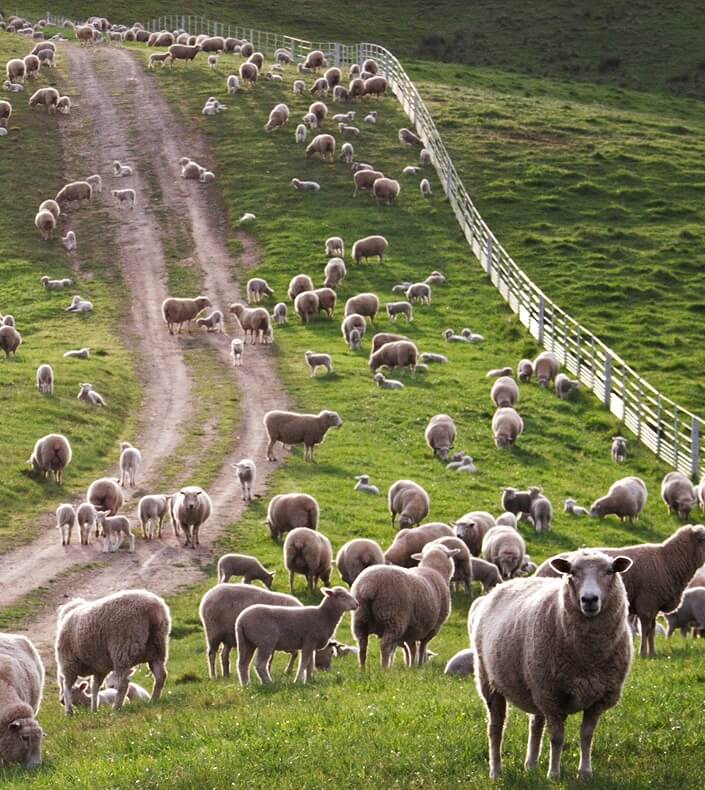
What sheep need, by class
These are approximate daily needs for a 50 kg Merino ewe in condition score 3 on pasture, based on Lifetime Wool, Making More From Sheep and NSW DPIRD figures. Heavier sheep, cold weather and walking long distances all push them up.
| Class | Energy (MJ ME/day) | Crude protein in diet | Water (L/day, mild weather) |
|---|---|---|---|
| Dry ewe, maintenance | 8 | 6 to 8% | 2 to 6 |
| Ewe, last 6 weeks, single | 12 to 13 | 8 to 10% | 2 to 6 |
| Ewe, last 6 weeks, twins | 15 to 16 | 8 to 10% | 2 to 6 |
| Ewe, lactating, single | 17 to 21 | 12 to 14% | 4 to 10 |
| Ewe, lactating, twins | 21 to 26 | 12 to 14% | 4 to 10 |
| Weaner, 30 kg, growing 100 g/day | 9 to 10 | 12 to 14% | 2 to 4 |
Water needs can rise by up to 80% in hot weather. They drop on lush green feed, which is mostly water. Rams need roughly 1.4 to 1.7 times the feed of a dry sheep, and should be in condition score 3.5 at joining.
Where the gaps usually are
Dry summer and autumn feed: energy and protein both fall, and protein often drops below what a growing weaner or pregnant ewe needs. Rumen microbes slow down on low-protein feed, so the sheep digests less of what it eats.
The break and spring flush: plenty of protein and water, but lush feed is low in fibre and dry matter. High potassium interferes with magnesium uptake, which is why grass tetany risk peaks on the best-looking feed.
Late pregnancy and lactation: demand jumps faster than appetite, especially in twin-bearing ewes.
Trace elements, by country: Australia’s old, weathered soils leave gaps that differ from district to district.
- Selenium: commonly short in southern country with more than 450 mm of rain, on light, acid soils, and on heavily fertilised clover pastures. Linked to ill-thrift and white muscle disease in lambs.
- Cobalt: short on many sandy and coastal calcareous soils. Sheep need it to make vitamin B12, and a shortfall shows up as ill-thrift and poor appetite.
- Copper: short on coastal sandy soils, sandy loams and swampy country, and tied up by high molybdenum and sulphur. Linked to steely wool, poor growth and swayback in lambs.
- Zinc: needed for skin, hoof and wool, and for immune function and fertility.
- Iodine and manganese: needed for lamb survival and fertility, with gaps in some districts.
Copper and sheep: copper poisoning is more common in sheep than in cattle, because the gap between enough and too much is narrow. Excess copper builds up in the liver. Know what your sheep are already getting from licks, premixes and drenches before adding more, and ask your vet or advisor if you’re unsure.
Green doesn’t mean balanced
The most common gap is the one nobody sees. A mob on lush green feed looks well, so it’s easy to assume its nutrition is covered. Often it isn’t.
- Lush feed can be up to 90% water. Sheep can fill up without taking in enough dry matter, energy or fibre.
- High potassium competes with magnesium. That’s why grass tetany risk peaks on the best-looking feed.
- Trace elements come from the soil, not the colour of the pasture. Fast-growing improved pastures can be lower in selenium and cobalt, and high molybdenum and sulphur tie up copper.
- The swings do the damage. Moving between dry and green feed creates peaks and troughs in nutrition, and they show up as condition changes, uneven conception, weak points in the wool and slower lambs.
Why year-round matters
Some nutrients, like magnesium and amino acids, can’t be stored in any useful amount, so the supply has to be steady. The paddock’s supply rises and falls through the year. A year-round program evens out those gaps instead of chasing them.
LivestockIQ’s year-round products are built to be dosed every 6 weeks, all year: nine three-day trough applications. That gives the best result for overall health, fertility, growth and wool.
If year-round isn’t possible, these windows are worth covering first:
| Window | Product | When to start |
|---|---|---|
| Pre-joining | StockForce or ULTRANEX | 12 weeks before rams go in |
| Late pregnancy and lactation | StockForce or ULTRANEX | 12 weeks before lambing |
| Grass tetany risk on lush feed | MagBoost (not for flocks on a selenium program) | About 6 weeks before lambing, then every 3 weeks |
| Weaning, trucking, containment or feedlot entry | StressGuard (contains selenium) | 3 to 7 days before, or on entry |
Protein isn’t the same as amino acids
Most of the protein a sheep eats is broken down by rumen microbes. The microbes build their own protein, which supplies a baseline of amino acids, but through pregnancy, lactation, growth and wool growth that baseline is often short.
Urea and non-protein nitrogen feed the microbes. They don’t supply the preformed amino acids the animal itself builds muscle, milk and wool from. Urea feeds the microbes. We feed the animal.
Where LivestockIQ fits
Every LivestockIQ product combines 16 amino acids from seagrass and kelp, chelated trace elements and natural electrolytes from fulvic acid. They’re rumen-protected, so they reach the small intestine, where the animal absorbs them. One three-day trough application supports the animal for up to six weeks.
| Your situation | Product | How often |
|---|---|---|
| Sheep on a selenium program (bullets, drench or injection) | StockForce | Every 6 weeks |
| No selenium program, or a mixed sheep and cattle operation | ULTRANEX | Every 6 weeks |
| Lush feed, late pregnancy and early lactation (grass tetany window) | MagBoost (not for flocks on a selenium program) | Every 3 weeks through the risk window |
| Weaning, trucking, containment or feedlot entry | StressGuard (contains selenium) | 3 to 7 days before, or on entry |
| Certified organic operations | OrganicMax* and OrganicGuard* | As for ULTRANEX and StressGuard |
* This product is allowable for use on farms (or in facilities) certified to the Australian Certified Organic Standard
LivestockIQ is targeted nutrition. The paddock provides the diet, and we deliver the specific nutrients it’s short on, in a form the animal can use. It works alongside your feed, licks and existing programs. It doesn’t replace energy or bulk feed.
FAQ
How do I know which trace elements my country is short of?
Your vet, district advisor or local stockist will know the common gaps in your area. Liver and blood tests give a clear answer for your own flock.
Do I still need licks or blocks?
In many cases, yes. LivestockIQ works alongside them. Producers commonly notice that sheep use less lick once they’re getting what they need from the trough.
Ready to set up your flock's program?
Your local reseller can help you choose the right product and timing.
Questions? Call (08) 8725 4668 or email [email protected]