

Transport
Even short trips cost weight. Cut shrink and get them back on feed.
Every truck trip costs weight. Some of it is gut fill that comes back once the sheep eat and drink. The rest is real liveweight and condition, and it grows the longer sheep are off feed and water and the more stressed they are. Good preparation cuts both, whether the sheep are heading to the saleyards, the processor, agistment or a new owner.
What’s going on
In the first hours off feed and water, sheep mainly lose gut fill. As time stretches out, they start losing body water and tissue, and that weight takes days to recover.
Stress adds to it. Mustering, yarding, mixing, noise and heat all raise stress hormones. That draws down energy reserves in the muscle, which can affect meat quality in sheep heading to slaughter. It can also suppress immune function in sheep going on to a new property or a feedlot.
The sheep that travel best are calm, well hydrated and in good condition before they leave.

What to watch for
- Sheep that aren’t fit to load: lame, weak or sick. Ewes in late pregnancy should never be trucked
- Long curfews before trucking
- Hot weather on travel day
- Slow return to feed and water after arrival
- Coughing, scouring or sheep off on their own in the week after arrival
Nutrition at this stage
Transport draws on reserves the sheep built up beforehand.
- Water and electrolytes: sodium and potassium are lost with body water, and dehydration drives much of the weight loss.
- Energy reserves: stress uses up the energy stored in muscle, which affects recovery and, for slaughter sheep, meat quality.
- Zinc, selenium and copper: support immune function, which stress pushes down for days after the trip.
- Amino acids such as threonine, arginine and glutamic acid: support gut health and recovery under stress.
Sheep straight off lush feed aren’t necessarily better prepared. They carry more gut fill, so they lose more weight in the first hours off feed, and they can scour on the truck. Sheep with steady nutrition in the weeks before travel tend to cope and recover better.
Where LivestockIQ fits
Sheep on a year-round program travel with steadier reserves. StressGuard then gives targeted support for the event itself.
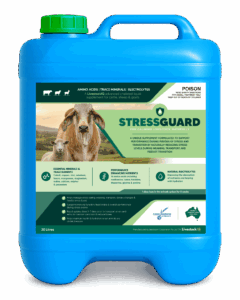
StressGuard is our stress and immune support product, and transport is the event it’s built around.
- Timing: dose 3 to 7 days before trucking. Never dose within 24 hours of loading, because a dose as the truck arrives is too late.
- Rates: 10 mL for adult sheep, 5 mL for lambs over 30 kg, 2.5 mL for lambs under 30 kg.
- What it does: it helps support hydration, calmer travel and a faster return to feed and water, and may help reduce weight shrinkage.
- Trough, tank or hay: use the ProDispenser in the trough, add the full dose to the tank closest to the stock, or apply a third of the dose to hay on each of three days. For a 9 am Monday truck, dose the tank by Friday morning or the hay on Thursday, Friday and Saturday.
- Buying sheep in? Add StressGuard to the water as they arrive, to help support their return to feed and water and their settling in.
StressGuard replaces your regular dose rather than adding to it. Allow at least 2 weeks since the last LivestockIQ dose, then pick the year-round program back up 6 weeks after StressGuard.
StressGuard contains selenium. If your flock is normally on StockForce because of a selenium program, follow the StressGuard dose rates and instructions exactly, and don’t dose dehydrated animals.
FAQ
My sheep are on StockForce. Do I need to wait six weeks before StressGuard?
No. As long as it’s been at least 2 weeks since the last dose, StressGuard can go in. If that means skipping a regular dose, that’s fine. Keep in mind StressGuard contains selenium, so follow the dose rates and instructions exactly, and don’t dose dehydrated animals.
Is it worth it for a short trip?
Even short trips involve mustering, yarding, curfew and mixing, and that’s where much of the stress comes from. Sheep going on to a new property or a feedlot get the most benefit.
Ready to set up your flock's program?
Your local reseller can help you choose the right product and timing.
Questions? Call (08) 8725 4668 or email [email protected]